Notes
|
Topics to be Learn :
|
Meaning and Definition of Double Entry Book-keeping System :
Introduction :
- The modern system of book-keeping and accountancy was first introduced by Luca Pacioli on 10 November 1494.
- The present system of accounting is a modified and improved form of the work developed over the last five centuries.
Meaning of Book-keeping : Book-keeping is the art of recording business transactions in a systematic manner in the books of accounts.
- Its main purpose is to find out the financial result (profit or loss) and the financial position of the business.
Double Entry Book-keeping System : According to the double entry system, every business transaction has two aspects. These two aspects are recorded in the books of accounts.
Definition : The recording of both aspects of a monetary transaction in the books of accounts using Debit and Credit is called the Double Entry System of Book-keeping.
Methods of Recording accounting information:
There are two methods of recording accounting information:
(i) Indian System.
(ii) English System : (a) Single Entry System (b) Double Entry System
(i) Indian System :
- In this system, business transactions are recorded in special books called ‘Bahi-khata’, ‘Kird’, etc.
- The records are usually written in Indian regional languages such as Marathi, Gujarati, Punjabi, etc.
- This system is traditional and mostly used by small traders and local businesses.
(ii) English System :
- In this system, business transactions are recorded systematically in books like Journal and Ledger.
- It is a more advanced and scientific system.
- It is widely used by most business organisations.
Types of English System
(a) Single Entry System : In this system, only one aspect of a transaction is recorded and the other aspect is ignored.
- Generally, only Cash Book and Personal Accounts are maintained.
- Therefore, it is considered an incomplete and unscientific system.
- It is suitable for small businesses and hawkers.
(b) Double Entry System : It is the most scientific, reliable, and complete method of recording business transactions. It records both aspects of every transaction.
Definition : According to J. R. Batliboi:
- Every business transaction has a two-fold effect.
- It affects two accounts in opposite directions.
- Therefore, one account is debited and another account is credited.
- Recording these two effects is called the Double Entry System.
Principles of Double Entry Book-keeping System :
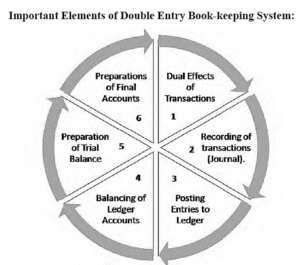
- Two Aspects of Every Transaction : Every business transaction has two effects – Debit and Credit.
- Two Accounts Involved : One account is the receiver of the benefit. The other account is the giver of the benefit.
- Debit and Credit Rule : If one account is debited, the other account must be credited. Every debit has an equal and corresponding credit of the same amount.
Advantages of Double Entry Book-keeping System :
- Complete Record : In this system, both aspects of every transaction are recorded. Therefore, it provides a complete and systematic record of all business transactions.
- Accuracy : In double entry system, every debit has a corresponding credit. This helps to check the arithmetical accuracy of the books of accounts on any date.
- Determination of Business Results : All expenses, incomes, losses, gains, assets, liabilities, debtors and creditors are properly recorded. Therefore, it becomes easy to find the correct profit or loss of a business for a particular accounting period.
- Common Acceptance : The records maintained under this system are widely accepted by financial institutions, banks and government authorities.
Conventional Accounting System (Traditional) :
- The Indian system of accounting, based on traditional practices and commonly accepted rules, is called the Conventional Accounting System.
- In this system, clear rules, concepts and conventions are not properly defined.
- It is an incomplete system of recording transactions because it does not fully follow the principles of the Double Entry System.
Classification of Accounts :
Meaning of Account : An account is a summarized record of transactions related to a particular person, asset, liability, expense or income, recorded at one place.
- In daily business activities, many transactions take place, and each transaction affects different accounts.
- After a certain period, the businessman balances these accounts to know important information such as: Total capital, Total assets and liabilities, Total income and expenses of the business.
Definitions of Account :
- According to G. R. Batliboi: “An account is a summarized record of transactions affecting one person, one kind of property or one class of gain or loss.”
- According to Carter: “An account is a ledger record in a summarized form of all the transactions that have taken place with the particular person or thing specified.”
Classification of Accounts :
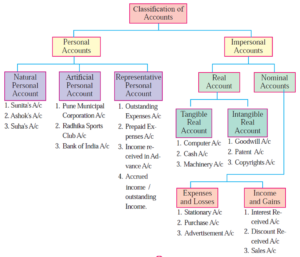
Accounts are mainly divided into two types:
- Personal Accounts
- Impersonal Accounts
(1) Personal Account : An account of a person or group of persons with whom the business deals is called a Personal Account.
Types of Personal Accounts :
(a) Natural Person’s Account : Accounts related to human beings or individuals.
- Examples: Parth’s A/c, Kalpana’s A/c, etc.
(b) Artificial Person’s Account : Accounts related to organisations or institutions created by law.
- Examples: Bank A/c, University A/c, Club A/c, etc.
(c) Representative Personal Account : Accounts that represent a person or group of persons with whom the business deals.
- Examples: Prepaid Insurance Premium A/c, Outstanding Salary A/c
(2) Impersonal Accounts :
All accounts other than personal accounts are called Impersonal Accounts.
Types of Impersonal Accounts
(A) Real Accounts : Accounts related to assets or properties owned by the business.
- Tangible Real Account : Accounts of assets that can be seen, touched and measured. Examples: Machine A/c, Cash A/c, Furniture A/c, etc.
- Intangible Real Account : Accounts of assets that cannot be seen or touched, but have value in money. Examples: Goodwill A/c, Patent A/c, Trademark A/c, Copyright A/c, etc.
(B) Nominal Accounts : Accounts related to expenses, incomes, losses, gains or profits. Examples: Wages A/c, Dividend A/c, Discount A/c, Rent A/c, etc.
Debit and Credit :
- Debit (Dr.): Left hand side of an Account is called Debit (Dr) side.
- Credit (Cr): Right hand side of an Account is called Credit (Cr) side.
Proforma of an Account
Dr. (Title of the Account) Cr.
| Date | Particulars | J.F. | Amount (₹) |
Date | Particulars | J.F. | Amount (₹) |
| 20…. | To …. A/c …. | -- | ---- | 20…. | By ….. A/c … | ---- | ---- |
Golden Rules of Debit and Credit (Traditional Approach):
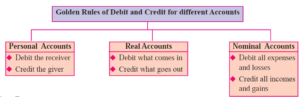
Illustration : I) From the following transactions find out
1) Two aspects 2) Two accounts 3) Classify the accounts
1) Commenced business with Cash ₹ 20,000.
2) Purchased goods on credit from Ajay ₹ 10,000.
3) Cash Sales ₹ 7,000.
4) Received commission ₹ 500.
5) Paid Rent ₹ 800.
Two Aspects, Two Accounts and Classify the Accounts.
| Sr.
No. |
Two aspects | Two accounts | Classification |
| 1. | Cash comes in
Proprietor (Capital) is the giver |
Cash A/c
Capital A/c |
Real A/c
Personal A/c |
| 2. | Purchases is an expense
Ajay is giver |
Purchases A/c
Ajay A/c |
Nominal A/c
Personal A/c |
| 3. | Cash comes in
Sales is an income |
Cash A/c
Sales A/c |
Real A/c
Nominal A/c |
| 4 | Cash comes in
Commission is an income |
Cash A/c
Commission A/c |
Real A/c
Nominal A/c |
| 5 | Rent is an expense
Cash goes out |
Rent A/c
Cash A/c |
Nominal A/c
Real A/c |
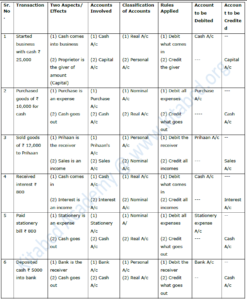
(1) Analysis of transaction by applying rules of Debit and Credit (Traditional Approach)
PROFORMA
| Sr. No. |
Transaction | Two Aspects/ Effects |
Accounts Involved |
Classification of Accounts |
Rules Applied |
Account to be Debited |
Account to be Credited |
| (1) | |||||||
| (2) |
Illustration : Prepare a chart showing analysis of the following transactions in a tabular form according to Traditional Approach :
(1) Started business with cash ₹ 25,000.
(2) Purchased goods of ₹ 10,000 for cash.
(3) Sold goods of ₹ 12,000 to Prihaan.
(4) Received interest ₹ 800.
(5) Paid stationery bill ₹ 800.
(6) Deposited cash ₹ 5000 into bank.
Classification of Accounts (Modern approach) :
In the following chart, different types of accounts have been summarised, which are divided into five categories for recording of the transaction :
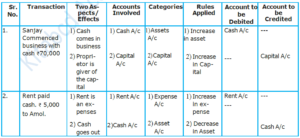
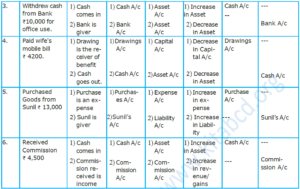
Analysis of transaction by applying rules of Debit and Credit (Modern Approach) :
PROFORMA
| Sr. No. |
Transaction | Two Aspects/ Effects |
Accounts Involved |
Categories | Rules Applied |
Account to be Debited | Account to be Credited |
| (1) | |||||||
| (2) |
Illustraion :
(1) Classify the following accounts into Personal, Real and Nominal accounts.
| 1) | Stationery A/c | 2) | Mahesh's A/c |
| 3) | Machinery A/c | 4) | Capital A/c |
| 5) | Loss by Fire A/c | 6) | Pune Municipal Corp. A/c |
| 7) | Building A/c | 8) | Bank of Maharashtra A/c |
| 9) | Copyright A/c | 10) | Repairs A/c |
| 11) | Laptop A/c | 12) | Wages A/c |
| Personal Account | Real Account | Nominal Account |
| Mahesh's A/c | Machinery A/c | Stationery A/c |
| Capital A/c | Building A/c | Loss by fire A/c |
| Pune Municipal Corp. A/c | Copyright A/c | Repairs A/c |
| Bank of Maharashtra A/c | Laptop A/c | Wages A/c |
(2) Classify the following accounts under Personal, Real and Nominal Accounts.
| 1) | Cash A/c | 2) | Outstanding Salary A/c | 3) | Rohit's A/c |
| 4) | Furniture A/c | 5) | Life Insurance Corp. A/c | 6) | Goodwill A/c |
| 7) | Prepaid Insurance A/c | 8) | Trademark A/c | 9) | Commission A/c |
| 10) | Loan A/c | 11) | Drawings A/c | 12) | Interest A/c |
| Personal Account | Real Account | Nominal Account |
| Outstanding Salary A/c | Cash A/c | Commission A/c |
| Rohit's A/c | Furniture A/c | Interest A/c |
| Life Insurance Corp. A/c | Goodwill A/c | |
| Prepaid Insurance A/c | Trademark A/c | |
| Loan A/c | ||
| Drawings A/c |
(3) Classify the following accounts under Assets, Liabilities, Income and Expenditure.
| 1) | Prepaid Rent | 2) | Salary A/c | 3) | Bank Loan A/c |
| 4) | Motor Car A/c | 5) | Rent Payable A/c | 6) | Bad Debts A/c |
| 7) | Copyright A/c | 8) | Interest Received A/c | 9) | Dividend Received A/c |
| 10) | Premises A/c | 11) | Insurance Premium A/c | 12) | Audit Fees A/c |
| Assets | Liabilities | Income/Gains | Expenditure/
Loss |
| Prepaid Rent A/c | Bank Loan A/c | Interest Received A/c | Salary A/c |
| Motor Car A/c | Rent Payable A/c | Dividend Received A/c | Bad debts A/c |
| Copy Right A/c | Insurance Premium A/c | ||
| Premises A/c | Audit Fees A/c |
(4) Classify the following accounts into Assets, Liabilities, Income, Expenditure and Capital.
| 1) | Land and Building | 2) | Interest Received | 3) | Computer |
| 4) | Sundry Creditors | 5) | Bills Receivables | 6) | Discount Allowed |
| 7) | Sundry Debtors | 8) | Goodwill | 9) | Freight |
| 10) | Discount Received | 11) | Bills Payable | 12) | Amit`s Capital |
| 13) | Interest on Fixed deposit. | 14) | Bank Overdraft | 15) | Live Stock |
| 16) | Printing & Stationery | 17) | Cash at Bank | 18) | Rent Received |
| 19) | Repairs & Maintenance | 20) | Carriage | 21) | Outstanding Rent |
| 22) | Commission Received | 23) | Bank Loan | 24) | Electricity Bill |
| 25) | Copyright |
| Assets | Liabilities | Income/Gains | Expenditure/Loss | Capital |
| Land & Building | Sundry Creditors | Interest Received | Discount Allowed | Amit`s Capital |
| Computer | Bills Payable | Discount Received | Freight | |
| Bills Receivable | Bank Overdraft | Interest on Fixed deposit. | Repairs & Maintenance | |
| Sundry Debtors | Outstanding Rent | Rent Received | Carriage | |
| Goodwill | Bank Loan | Commission
Received |
Printing and
Stationary |
|
| Live Stock | Electricity Bill | |||
| Cash at Bank | ||||
| Copyright |
Accounting Equations :
Accounting equation signifies that the assets of a business are always equal to the total of its liabilities and capital. This fact can be represented in terms of accounting equation as follows :
Assets = Liabilities + Capital OR A = L + C
Total Assets = Total Liabilities
Assets = Liabilities
- The property of every description owned and possessed by the business is called asset.
- The rights of proprietor to the assets are called equities.
- The equity of creditors and the equity of owners represents debts of business and capital respectively.
Accounting equation for a transaction :
Example:-
(1) Rahul started business with Cash ₹ 50,000.
The accounting equation will be- Assets = Capital + Liabilities
Cash = Capital + Liabilities
₹ 50,000 = ₹ 50,000 + 0
₹ 50,000 = ₹ 50,000
(2) Rahul purchased Machinery from H.P. Co. on credit of ₹10,000.
The accounting equation will be- Assets = Capital + Liabilities
Cash + Machinery = Capital + Sundry Creditors
₹ 50,000 + ₹ 10,000 = ₹ 50,000 + ₹ 10,000
₹ 60,000 = ₹ 60,000
(3) Rahul purchased goods ₹ 20,000.
The accounting equation will be- Assets = Capital + Liabilities
Cash + Machinery + Stock = Capital+ Sundry Creditors
Old Bal. ₹ 50,000 + ₹ 10,000 + 0 = ₹ 50,000 + ₹ 10,000
New Transaction ₹ 30,000 + ₹ 10,000 + ₹ 20,000 = ₹ 50,000 + ₹ 10,000
New Balance. ₹ 30,000 + ₹ 10,000 + ₹ 20,000 = ₹ 50,000 + ₹ 10,000
₹ 60,000 = ₹ 60,000
Illustration–:
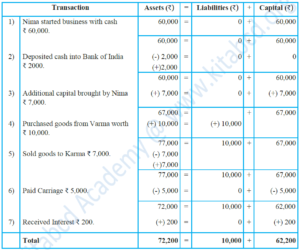
(1) Give the accounting equation for the following transactions-
- Nima started business with cash ₹ 60,000
- Deposited cash into Bank of India ₹ 2000
- Additional capital brought by Nima ₹ 7,000
- Purchased goods from Varma worth ₹ 10,000
- Sold goods to Karma ₹ 7,000
- Paid Carriage ₹ 5,000
- Received Interest ₹ 200
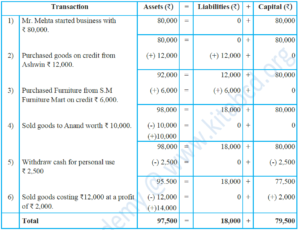
(2) Show the accounting equation for the following transactions-
- Mehta started business with ₹ 80,000
- Purchased goods on credit from Ashwin ₹ 12,000.
- Purchased Furniture from S.M Furniture Mart on credit ₹ 6,000
- Sold goods to Anand worth ₹ 10,000.
- Withdrew cash for personal use ₹ 2,500
- Sold goods costing ₹ 12,000 at profit of ₹ 2,000.
We reply to valid query.